
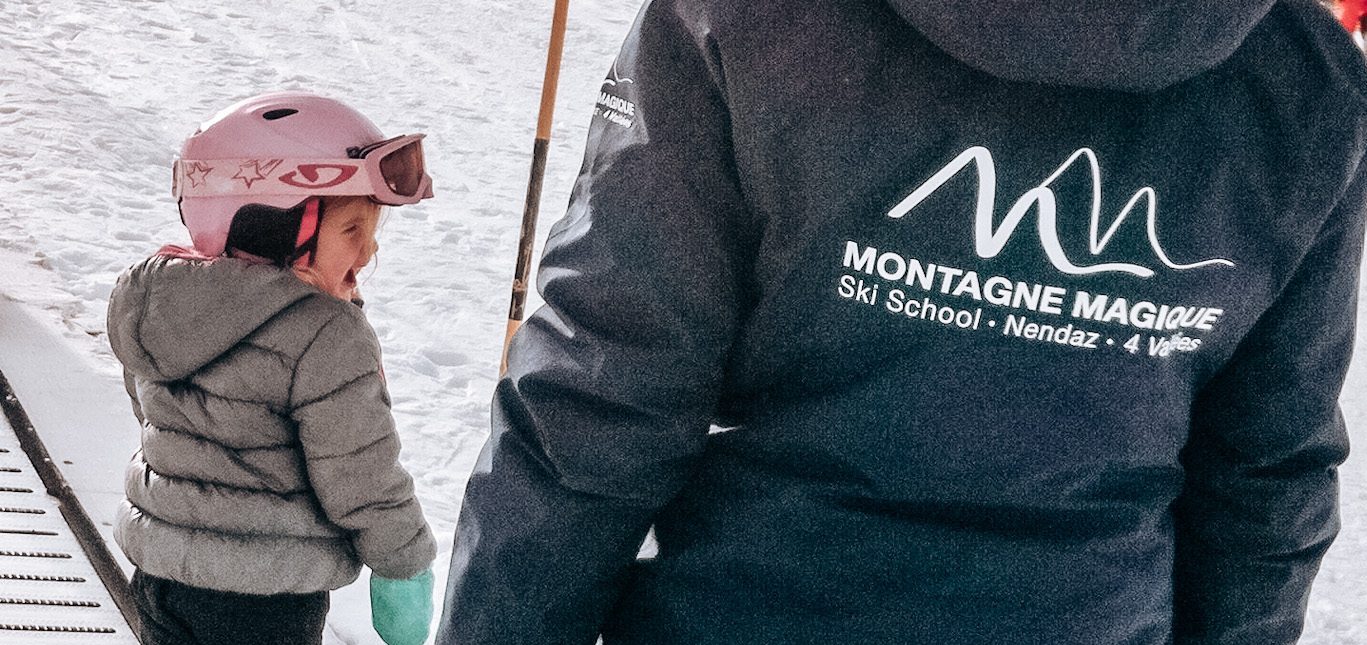
When can children start to learn to ski?
We often get asked at what age can children learn to ski as well as –
- “At what age should I get my child skiing?”
- “Is 2/3 years old too young to start skiing?”
- “What’s the best age to start skiing?”
- “What is the youngest age you will teach from?”
Signs your child is ready to start skiing
Age is a useful guide, but it isn’t the only thing that matters. Alongside the 3–4 age range we mention above, a few signs can tell you more about whether your child is ready:
- They can follow a simple instruction and give it a try. Skiing lessons rely on children being able to take in a short instruction, such as “put your hands on your head”, and have a go. They don’t need to get it right straight away.
- They’re comfortable playing in snow or cold weather. If they’ve already spent some time outside in the cold, the snow itself won’t be another completely new experience to deal with.
- They’re generally comfortable being looked after by another trusted adult. At this age, most children do best in a private lesson without a parent watching from the sidelines. Children often behave quite differently — and often much better — once mum or dad isn’t in sight!
If your child ticks most of these boxes but isn’t quite 3 yet, it can be worth waiting another season rather than pushing it. A positive first experience is much more important than starting as young as possible.
Frequently asked questions
What age can kids start skiing?
Many children are ready to start skiing around 3 to 4 years old, although every child develops differently. Some confident 3-year-olds do brilliantly, while others aren’t quite ready until they’re closer to 5. Both are completely normal.
Is there a “best” age, or does it depend on the child?
There’s a useful age range – around 3 to 4 – but readiness matters more than the exact age. A confident, curious 3-year-old who is comfortable with new adults and new environments can do just as well as a more cautious 4-year-old.
When should your child start skiing if you’re planning a family ski trip?
If you’re planning your first family ski holiday, age 4 can often be an easier starting point than age 3, simply because slightly older children tend to settle into lessons more quickly. But it’s not a rule. Younger children can do very well with the right instructor, a private lesson and a pace that suits them.
What’s the youngest age you’ll teach from?
We’re happy to assess younger children individually, but as a general guide, most children under 3 find the boots, cold weather and being separated from a parent more challenging than the skiing itself, but that said we would still happily take them for a lesson.
Can a 2-year-old learn to ski?
It’s possible, but uncommon. At this age, the challenge is often less about skiing and more about coping with ski boots, cold hands and a new adult giving instructions for an hour.
For many 2-year-olds, simply playing in the snow is much more enjoyable than a structured ski lesson — and that’s a perfectly good way to spend their first trip to the mountains.
Does starting later put a child behind?
Not necessarily. Children who start at 6 or 7 can progress very quickly because they’re often able to understand and follow instructions more easily. Starting early isn’t essential for becoming a confident skier — it simply gives a child more years to enjoy skiing, and general guidance from other resorts backs this up too.

What to expect from your child’s first ski lesson
Once you’ve settled on the right time to start, here’s what you can expect on the day.
A littles ones first lesson is as about building confidence and trust with the instructor, so we use plenty of play whilst getting them used to the environment.
The first 15–20 minutes will be about getting usded to all the new feelings of the equipment. We’ll get your child comfortable in their boots, practise walking in them and turn the whole thing into a game rather than a task.
Once they’re relaxed, we’ll introduce the basics: how to stand on their skis, move around of them, shuffling, sliding and stepping, which are the fundamentals of them becoming independent on the skis. Then we would move on to getting them sliding down a very small gradient and getting them used to this feeling! Falling is completely normal — and often one of the parts children enjoy most!
Because we teach private lessons at this age rather than groups, the pace is entirely determined by your child. Some children will be linking their first turns within a single session; others will spend most of the first lesson getting used to the equipment. Both are perfectly good outcomes.
We’d always rather a child finishes their lesson excited to come back than pushed beyond the point where they’re enjoying themselves.
What equipment does my child need?
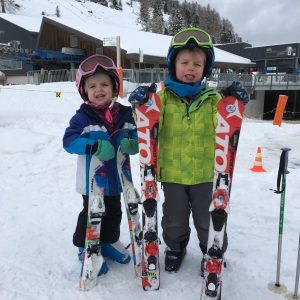
Beyond what we already mention above about mittens and boots, a few things can make those first lessons noticeably easier:
- Boots that fit snugly but aren’t painful. Boots that are too big can be one of the reasons young children struggle, as they make it harder to feel and control the skis.
- A helmet. We require helmets for all children’s lessons, both for safety and for peace of mind.
- Mittens. Are much easier to take on and off and can save a lot of time and generally tend to keep hands warmer.
- Layers rather than one thick coat. Children can warm up quickly once they’re moving, so being able to remove a layer during the lesson can make a big difference.
- Sun protection. Snow glare at altitude can be intense, even on cloudy days, so sunglasses or goggles are essential as is suncream!
- Snacks. Put a little snack in their pocket to keep them going, it leads to a natural break and kids can be very excited about snack!
If you’re unsure about sizing, or what to rent locally versus bring from home, just ask us when you book. We’re happy to advise before you arrive rather than have you guess.
Ready to get your child on skis?
If you’re wondering whether your child is ready to start skiing, we’re happy to help. Tell us their age and a little about them, and we’ll recommend the right lesson and approach for their first time on the slopes.


 English (United States)
  French
  Dutch
Dutch